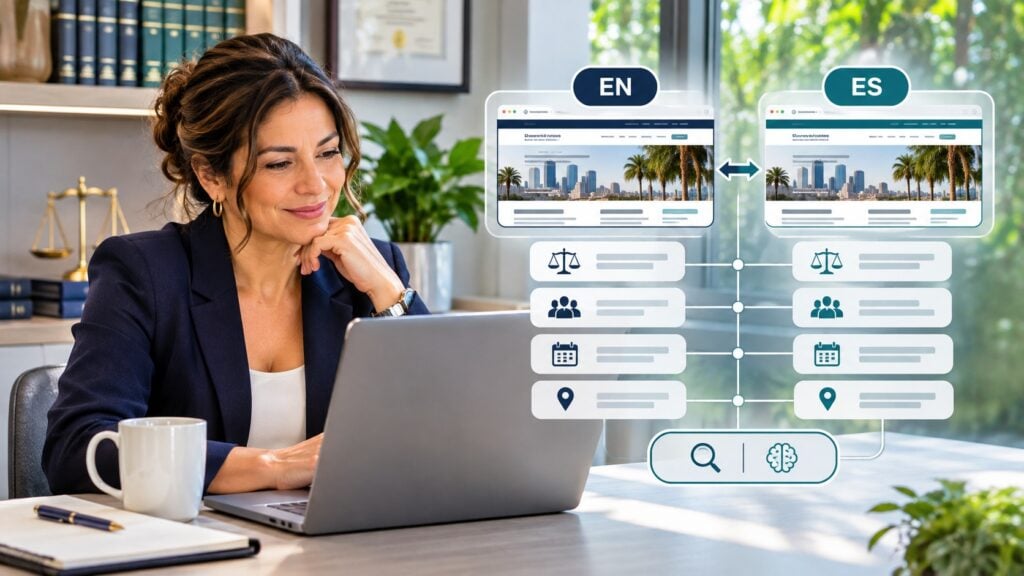
A firm can add Spanish words to a website without creating a genuinely bilingual online presence.
The harder question is whether a Spanish-speaking prospective client can find the right service, understand who will help them, verify the firm, and reach someone who can continue the conversation in Spanish.
For U.S. professional firms, bilingual visibility therefore has two jobs: make the Spanish information understandable to search systems, and make the promise accurate for the people who rely on it.
The Core Answer: What Does a Bilingual Online Presence Require?
A bilingual online presence is more than a translated homepage. For a U.S. professional firm, important pages should have real Spanish counterparts on their own URLs, the language versions should be clearly connected, and the Spanish should accurately explain the firm’s services, people, locations, and next steps. Most importantly, the firm must actually be prepared to serve the client in Spanish.
A bilingual online presence does not guarantee rankings, AI citations, or new clients. It makes a firm easier for Spanish-speaking clients to find, understand, and trust, provided the firm can truly serve them in Spanish.
Google itself distinguishes between multilingual websites, which offer content in more than one language, and multi-regional websites, which target users in different countries or regions. Google says Search tries to find pages matching the searcher’s language. Google’s guidance for multilingual and multi-regional sites
For a professional firm, that technical distinction is only the beginning.
The Spanish experience also has to make sense when a prospective client leaves Google, opens the page, reviews the firm, submits a form, or calls the office.
Key Takeaways
- A translated homepage alone is not a complete bilingual presence.
- Google recommends separate URLs for separate language versions.
- English and Spanish counterparts should be connected so search engines can understand their relationship.
- Google says it determines page language from the page’s visible content, not from the URL or the HTML lang attribute.
- Each page should primarily use one language rather than placing full English and Spanish versions side by side.
- Spanish service pages should clearly establish the firm’s U.S. professional and geographic context.
- Geographic signals can help communicate intended audience, but Google says geotargeting is not exact.
- Automatic translation is not inherently prohibited by Google, but scaled low-value translated pages can fall within Google’s spam policies.
- High-trust professional content should receive fluent human review for terminology, accuracy, and service truth.
- A firm should translate the pages that matter to the client journey before trying to translate everything.
- The online promise must match the firm’s real Spanish-speaking intake and service capacity.
- Google documents no special multilingual optimization requirement for AI Overviews or AI Mode.
Why Is a Translated Homepage Not Enough?
A homepage introduces the firm.
It rarely answers the entire client question.
Suppose an attorney’s homepage exists in Spanish, but the estate-planning page does not.
Or a CPA says “Hablamos español” on the homepage, but the tax-service explanations, professional biographies, contact instructions, and appointment process remain available only in English.
The site may technically contain Spanish.
The client journey is still mostly English.
That matters for search too.
Google recommends using different URLs for different language versions of a page rather than dynamically changing the language at the same URL based on cookies or browser preferences. Google’s multilingual-site guidance
That means the stronger architecture is not:
One English page with a translation widget
It is:
English service page → corresponding Spanish service page
English professional profile → corresponding Spanish professional profile
English contact path → understandable Spanish contact path
The pages do not need to be literal word-for-word copies.
They need to communicate the same real service accurately.
This is where the broader principles of what a clear service page includes still apply.
A Spanish-speaking client should be able to understand:
- what the service is,
- who provides it,
- who it is for,
- where the firm operates,
- what the firm can and cannot help with,
- what the next step is.
Translation is the language layer.
Service clarity is the business layer.
A bilingual presence needs both.
How Do Google and AI Search Handle Two Languages on One Site?
Google gives site owners fairly clear multilingual guidance.
The implementation can become technical, but the concepts are straightforward.
Use Separate URLs for Separate Languages
Google recommends different URLs for each language version.
That could mean different folders or another sensible site structure.
The important part for this article is not the code.
It is that the Spanish page should exist as a real crawlable destination rather than only appearing after a visitor changes a browser preference or activates a translation overlay.
Google warns that when content changes dynamically according to language settings, it may not discover and crawl every variation. Google’s current multilingual guidance
Connect the English and Spanish Versions
Google recommends telling it about localized versions of a page so Search can understand that they are related variants.
Google supports several implementation methods and says the purpose is to help Search point users toward the appropriate language or regional version. Google’s localized-page documentation
The firm owner does not need to learn the underlying code to understand the requirement.
The useful question for the web team is:
“Can Google clearly tell that this Spanish page is the counterpart of this English page?”
Make the Language of Each Page Obvious
Google says it determines the language of a page from visible content.
It does not rely on the URL or HTML lang attribute to determine language.
Google recommends using a single language for the page content and navigation and avoiding full side-by-side translations. Google’s guidance on making page language clear
For the reader, this also creates a cleaner experience.
A Spanish page should feel like a Spanish page.
Let People Switch Languages
Google recommends giving users links that let them choose another language version and warns against automatically forcing visitors from one language version to another based on assumptions about their language. Google’s multilingual user-experience guidance
That is a useful principle for professional firms too.
Language choice should be easy.
It should not become a barrier.
Where Does AI Search Fit?
Google says the same foundational SEO practices remain relevant to AI Overviews and AI Mode, and that no special optimization is necessary for those features. Google’s guidance for AI features in Search
Eligibility is a separate question. Google’s newer guide says a page must be indexed and eligible to appear in Search with a snippet, and the site must be included in Search generative AI features in Search Console. Google’s guide to generative AI features in Search
Google describes inclusion as the default setting, so for most firms this is something to confirm rather than something new to build. Search Console’s generative AI control
None of these pages sets a separate requirement for Spanish or bilingual content.
Google does not publish a separate formula saying that a bilingual page receives more AI visibility because it is bilingual.
So the responsible approach is simple:
Build the Spanish pages correctly for users and normal Search.
Keep them crawlable, useful, accurate, and connected to their English counterparts.
Do not invent a separate “Spanish AI SEO” mechanism that Google has not documented.
Is Automatic Translation Enough?
Automatic translation can be useful technology.
It is not the same thing as a finished professional-language experience.
Google’s current spam policy does not say that automated translation is automatically prohibited.
Google defines scaled content abuse as producing many pages primarily to manipulate rankings rather than help users. One of its examples is scraping feeds, search results, or other content to generate many pages, including through automated transformations such as translation, where little value is provided to users. Google’s current spam policies
That distinction matters.
The problem is not simply:
“A machine touched this sentence.”
The larger questions are:
- Is the page useful?
- Is the service described accurately?
- Is the terminology appropriate?
- Are important qualifications preserved?
- Does the Spanish reflect what the firm truly offers?
- Has someone qualified to judge the language reviewed it?
For a restaurant menu, an awkward translation may be inconvenient.
For an attorney, CPA, financial advisor, mortgage professional, or insurance agency, the wrong word can change the meaning of a professional service.
That is why Evoltra recommends fluent human review before professional Spanish content is published.
That recommendation is about accuracy and trust.
It should not be presented as a secret Google ranking requirement.
What Makes Spanish Content Trustworthy?
Natural Spanish matters.
But trustworthy professional Spanish involves more than grammar.
Use Stable Professional Terminology
A firm should not describe the same service three different ways simply because different translation passes produced different vocabulary.
Terminology should remain understandable and consistent across:
- service pages,
- professional biographies,
- forms,
- calls to action,
- FAQs,
- profile descriptions,
- follow-up communication.
Consistency is especially important when the Spanish term carries a professional meaning.
The firm does not need to hide legitimate regional vocabulary differences.
It does need to decide how it describes its own services.
Preserve the Meaning, Not Just the Sentence Structure
A useful Spanish page does not need to imitate English syntax.
It needs to preserve the actual meaning.
That includes:
- qualifications,
- limitations,
- service scope,
- professional role,
- geographic availability,
- calls to action,
- compliance-approved language.
If an English statement is carefully qualified, the Spanish version should not accidentally turn it into a stronger promise.
Keep Professional Identity Consistent
The Spanish page should still describe the same real firm and the same real professionals.
Names, roles, offices, service areas, approved credentials, and contact paths should not conflict simply because the language changed.
This becomes part of the same verification problem Evoltra discusses in when online profiles tell different stories.
If the Spanish website says one thing and the English website or public profiles say another, the prospective client has to decide which version is current.
That uncertainty is avoidable.
Avoiding it is part of what authority means in Google and AI search: a coherent public body of information that makes the firm easier to understand and verify.
A bilingual presence should strengthen that body of information, not fragment it.
Why Does U.S. Context Matter in Spanish Content?
Spanish is a language.
It is not a country.
A Spanish page written for a professional firm in Florida, Texas, New York, California, or another U.S. market should make its actual service context clear.
That is important for the reader first.
Someone landing on the page should not have to guess:
- whether the firm operates in the United States,
- which state or market it serves,
- which professional system the service belongs to,
- whether the professional is describing a U.S. legal, tax, mortgage, financial, or insurance service,
- how to contact the U.S. office.
Google’s multilingual documentation also distinguishes language targeting from regional targeting.
Google says regional signals may include locale-specific URLs, local addresses and phone numbers, local language and currency, links from local sites, and information from Business Profiles. Google also explicitly says that geotargeting is not an exact science. Google’s guidance on targeting site content to a country or region
For a U.S. professional firm, practical clarity may include:
- naming the relevant U.S. city, state, or service area where appropriate,
- identifying the actual U.S. office,
- describing the service within its real U.S. professional context,
- using approved terminology connected to the firm’s actual practice,
- making U.S. contact information easy to find,
- identifying the professionals who will provide the service.
Those details should exist because they are true and useful.
They should not be inserted as a formula for forcing U.S. rankings.
Google itself warns against thinking of geographic targeting as precise.
Which Pages Should a Firm Put in Spanish First?
A firm does not necessarily need to translate its entire website on day one.
The better starting point is the client journey.
Ask:
Which pages would a Spanish-speaking prospective client need in order to understand the service, evaluate the firm, and make contact?
A useful priority framework is:
| Priority | Page type | Why it matters |
| 1 | Primary service pages | Explain what the firm actually provides |
| 2 | Professional biographies | Show who will serve the client |
| 3 | Contact and intake pages | Make the next step understandable |
| 4 | Important office or location pages | Establish where the firm operates |
| 5 | About page | Explain the firm and its professional context |
| 6 | High-value educational pages | Answer recurring questions that support the service |
| 7 | Supporting articles | Expand depth once the core journey is complete |
Start With Services
If Spanish-speaking clients cannot understand the service itself, the rest of the bilingual experience has limited value.
The most important service pages should explain the real offering in natural Spanish with the same care given to English.
Translate the People, Not Just the Firm
Professional services are delivered by people.
If a firm says it serves clients in Spanish but the professional biographies are available only in English, the client may still be left asking:
Who will actually help me?
A Spanish biography should accurately explain the person’s role and, where true and approved, their ability to communicate professionally in Spanish.
Make Contact Understandable
A Spanish service page that ends in an English-only form with unclear labels creates a broken transition.
The same is true if a Spanish page offers a phone number but the caller has no realistic way to reach someone who can continue in Spanish.
The contact experience does not need to be elaborate.
It needs to be truthful.
What Happens After a Spanish-Speaking Client Reaches Out?
This is where a bilingual marketing promise becomes an operational promise.
A prospective client may find a Spanish page through Google.
They may read the page comfortably.
They may understand the service.
Then they call.
What happens next?
The Phone
If the firm advertises Spanish-speaking service, there should be a realistic path for a Spanish-speaking caller.
That does not mean every employee must speak Spanish.
It means the public promise should match the actual system.
If Spanish-speaking assistance is available only through specific team members, the firm can communicate that honestly.
The Form
Spanish pages should not lead into an intake process the client cannot understand.
Important instructions, consent language, and next-step explanations should receive the same appropriate professional and compliance review as the public page.
The Follow-Up
The first Spanish interaction should not suddenly switch into an unexplained English-only process.
A firm should know:
- who receives Spanish-language inquiries,
- who can respond,
- how the inquiry reaches the right professional,
- what happens when that person is unavailable.
Technology can help route or acknowledge inquiries, but it should not pretend to provide language capability the firm does not actually have.
Evoltra’s explanation of what an AI intake system is shows how phone, website, and follow-up systems can support the handoff without replacing professional judgment.
The principle here is more basic:
Do not advertise a bilingual experience that ends when the prospect reaches the intake system.
Are There Professional Rules About Advertising in Another Language?
Potentially, depending on the profession, jurisdiction, content, and type of communication.
This article does not interpret those rules.
Attorneys should review the rules and guidance applicable to their jurisdiction.
Financial advisors, mortgage professionals, CPAs, insurance agencies, and other regulated firms should follow the requirements and internal compliance processes that apply to their own professions and communications.
The operational rule is straightforward:
The Spanish version deserves the same compliance attention as the English version.
Translation should never become a way of weakening, removing, or unintentionally changing a qualification or disclosure.
When there is uncertainty, the firm’s regulator, bar, compliance team, or qualified counsel is the appropriate source for profession-specific guidance.
How Should a Firm Think About Bilingual Visibility as a Whole?
A bilingual presence works best when it is treated as one connected system.
The Spanish website should not become a smaller, forgotten version of the English site.
The two language layers should describe the same real firm.
They should connect the same important services.
They should identify the same professionals accurately.
They should give clients a workable path into the firm.
And they should be maintained when something important changes.
That includes:
- new services,
- changed office locations,
- new professional biographies,
- updated contact information,
- revised compliance language,
- retired services,
- changed calls to action.
A bilingual site can create more public information about the firm.
That makes consistency more important, not less.
When someone later searches the firm’s name, the Spanish pages become part of what prospects see when they search your firm by name.
The objective is one firm, clearly represented in two languages.
The Bottom Line
A bilingual online presence is not created by adding a Spanish button to the homepage.
It is created when the important parts of the client journey work in Spanish.
For U.S. professional firms, that means:
- separate Spanish URLs for important pages,
- clear relationships between English and Spanish versions,
- real Spanish service information,
- accurate professional identities,
- clear U.S. geographic and professional context,
- understandable contact and intake paths,
- fluent review of important terminology,
- compliance review appropriate to the profession,
- actual human capacity to continue serving the client in Spanish.
Google gives site owners clear multilingual foundations: separate language URLs, explicit connections between localized versions, visible page language, and user-controlled language switching.
Google also makes an important boundary clear.
Regional targeting is not exact.
And its AI Search documentation does not provide a special multilingual formula for earning AI citations.
That leaves professional firms with a simpler responsibility.
Build Spanish pages for real people.
Make the U.S. context clear because it is true.
Keep the information consistent.
And make sure the experience after the click fulfills the promise made before it.
Firms reviewing the website layer can explore Evoltra’s AEO Website Optimization service. Firms evaluating the broader consistency of their public presence can also begin with the Authority Score assessment.
A bilingual online presence does not guarantee rankings, AI citations, or new clients. It makes a firm easier for Spanish-speaking clients to find, understand, and trust, provided the firm can truly serve them in Spanish.
Frequently Asked Questions
Is an automatic translation plug-in enough for a bilingual professional website?
Usually not as the complete bilingual architecture.
Google recommends separate URLs for separate language versions and warns that dynamically changing language on the same URL may prevent all versions from being discovered and crawled.
An automatic translation system may help create or display language content, but a professional firm still needs to evaluate whether important Spanish pages exist as crawlable destinations and whether the final Spanish accurately represents the firm’s services.
Does a firm need a completely separate Spanish website?
No.
A separate Spanish domain is not required.
Google’s documented URL-structure options include language sections within a single domain, so English and Spanish pages can live on the same website at separate URLs.
The important concepts are distinct URLs, clear language versions, and understandable connections between them.
Which pages should a professional firm translate into Spanish first?
Start with the pages most important to becoming a client:
- primary service pages,
- professional biographies,
- contact and intake pages,
- important office or location pages,
- the main firm or About page.
After that, translate educational content that supports the services Spanish-speaking clients actually use.
Does Spanish content need U.S. geographic context?
For a U.S. professional firm, clear U.S. context is useful because it helps the reader understand where the firm operates and which professional environment the information refers to.
Google also documents geographic signals such as local addresses, phone numbers, localized URLs, local links, and Business Profile information.
Those signals do not guarantee U.S. rankings. Google says geographic targeting is not exact.
What if only one person at the firm speaks Spanish?
Say what the firm can actually provide.
If one qualified team member handles Spanish-speaking clients, the website can explain that accurately rather than implying that every employee is bilingual.
The intake process should also have a realistic way to route Spanish-speaking inquiries to that person.
Does bilingual content improve AI visibility?
There is no documented guarantee.
Google says normal SEO best practices remain relevant to AI Overviews and AI Mode and that no special optimization is necessary for those features.
Eligibility is a separate matter. The page must be indexed and eligible to appear with a snippet, and the site must be included in Search generative AI features in Search Console, which Google describes as the default setting.
A well-structured Spanish page may be eligible on the same terms as any other page, but publication in Spanish does not guarantee an AI citation or mention.
Does Google penalize automatically translated content?
Google does not document automatic translation itself as an automatic penalty.
Its spam policy targets scaled content created primarily to manipulate rankings. One of its examples is scraped content turned into many pages through automated transformations, such as translation, that provide little value to users.
For a professional firm, the more immediate concern is whether the translated material is accurate, useful, and professionally appropriate.
Should every English article have a Spanish version?
Not necessarily on the first day.
A firm should first make sure the core Spanish client journey is complete.
After that, maintaining paired educational content can make sense when the subject is genuinely useful to the firm’s Spanish-speaking audience.
Volume should not come before service relevance or translation quality.